Material Intelligence, no. 17: Palm (Mar., 2026)
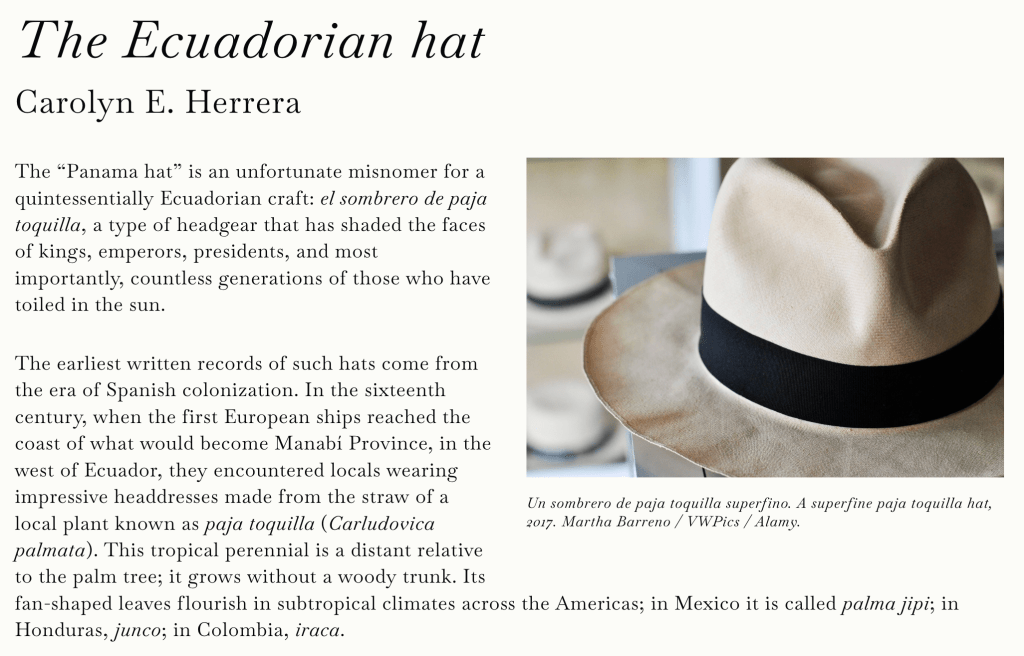
“The earliest written records of such hats come from the era of Spanish colonization. In the sixteenth century, when the first European ships reached the coast of what would become Manabí Province, in the west of Ecuador, they encountered locals wearing impressive headdresses made from the straw of a local plant known as paja toquilla (Carludovica palmata). This tropical perennial is a distant relative to the palm tree; it grows without a woody trunk. Its fan-shaped leaves flourish in subtropical climates across the Americas; in Mexico it is called palma jipi; in Honduras, junco; in Colombia, iraca.
In Ecuador, paja toquilla grows naturally on both sides of the Andes, and has historically served as a material for buildings, medicine, and food. The original toquilla hats were eminently practical. Though lightweight, they were impressive in scale, and so tightly woven that they effectively blocked the Equatorial sun and were also watertight. In a pinch, they could even be used as drinking vessels.
Before long, the craft became an esteemed commodity within the Spanish Empire.. . .”
 Aloevera Herrera